Harrod Ford
The Vampire Prince’s BrideHarrod Ford is introduced as a young man living under extraordinary protection and extraordinary loneliness. He is the charming grandson of an oil tycoon and the son of the Director of the Central Intelligence Agency, yet wealth and security have not made his life ordinary. Two vans follow him wherever he goes, black-suited guards surround the family’s mansion, and the expensive house is described as largely empty of companionship. His significance lies in the contradiction at the center of his existence: he has been guarded as if he were valuable, but kept uninformed as if he could not be trusted with the truth about himself.
Identity and Background
Harrod is twenty-five when the narrative begins, old enough to have established an adult life but still treated by his family as someone who must be protected from knowledge. He is studying for a degree and appears, from the outside, to lead a privileged and carefully managed life. The mansion, the security detail, and his connection to the Central Intelligence Agency create an atmosphere of institutional power around him, while his grandfather’s oil fortune supplies the family’s immense material wealth. Inside that enclosure, however, Harrod experiences isolation rather than comfort. He waits for his father to return to the house, finds himself alone after the butler retires, and longs for a form of normalcy he cannot define because surveillance has surrounded him since childhood.
The narrative gives this isolation a physical setting. Harrod sits on the front steps while the sky changes from blue to orange, pink, red, purple, and finally black, imagining how the brightly lit mansion might look from above and recognizing that its costly lights serve almost nobody. The image is not merely decorative: the house is both fortress and prison, a place designed to secure the family while preventing genuine intimacy. His questions concern not only his unexplained condition but also his absent father, his mother, and the rules governing the life into which he was born.
Sleep Terrors and Revelation
Harrod’s transformation begins with sleep terrors that are entirely unfamiliar to him. In a therapist’s office, he stares at soothing green walls, cracks his knuckles in a newly acquired nervous habit, and repeatedly returns in memory to the previous night’s dream. The experience gives him shivers and makes him feel as though puberty has returned, suggesting that his body is changing before his understanding can catch up with it. The therapist’s professional setting initially frames the problem as psychological, but the later family conversation reveals that the terror is a symptom of a hidden biological inheritance.
His father finally tells him that he is a werewolf and that the rest of the family shares the condition, with the exception of Harrod’s mother. The revelation also recasts his mother’s earlier behavior. His father admits that he should have prepared her for the truth but instead believed she would never discover it. Harrod’s disbelief is immediate and profane, because the disclosure overturns the ordinary explanation of his life all at once. The family’s secrecy has not protected him from fear; it has deprived him of the language needed to understand his own body.
This discovery places Harrod within a hereditary supernatural structure rather than presenting lycanthropy as an isolated accident. His father and grandfather are not simply wealthy relatives or political figures; they are members of a werewolf family with its own pack, rites, hierarchy, and expectations. The contrast between official power and hidden animal identity is central to Harrod’s characterization. The family can command security resources and public influence, yet its most consequential truth is maintained as a private secret.
Training and Alpha Trial
Harrod’s initiation into the werewolf world culminates in a formal challenge witnessed by the entire den. On his last night there, he stands at the edge of the pit beneath a bright full moon while fog reduces visibility around the surrounding wolves. Harrison waits across from him, and Harrod’s father and grandfather observe from a cliff two stories above the arena. Siobhan is the only human presence among the wolves, but she insists on watching even after Harrod tells her she does not have to. Her presence connects the private emotional stakes of his transformation to the public ritual of pack succession.
The ceremony begins with Harrod’s grandfather howling toward the moon. Harrod’s father joins on the second howl, and the whole pack answers on the third. The repeated sound turns the contest into a collective act of recognition rather than a merely private fight. When Harrod wins, his grandfather announces that the pack has a new Alpha. Harrison, injured enough to be carried away from the pit on a gurney, still tells Harrod that he is fine and that Harrod played well, adding that he trained him properly. Victory therefore does not erase the relationship between student and teacher; it confirms the training that made the victory possible.
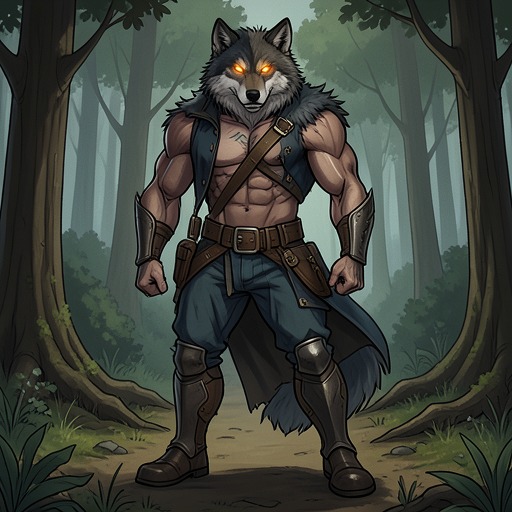
The declaration goes further than ordinary succession. Harrod is recognized as a True Alpha, a rare status associated with bloodmoons for eyes and the exceptional control required to maintain a form between animal and man. The pack’s howls function as both celebration and political ratification. Harrod has not merely survived the revelation of his condition; he has demonstrated mastery of it before the community whose judgment determines his authority. His control becomes the visible answer to the fear that first appeared as sleep terror.
Relationships and Conflicts
Harrod’s relationship with his father is shaped by affection, authority, and concealment. His father provides the explanation Harrod needs, but only after years of silence and after the symptoms become impossible to ignore. The delayed disclosure explains why Harrod experiences the truth as an intrusion rather than a carefully guided inheritance. His grandfather, by contrast, occupies the public role of pack elder and ceremonial judge. He watches the trial from above, announces the result, and praises Harrod’s rare status with unmistakable pride.
Siobhan is important to Harrod’s transition because she chooses to remain present when the supernatural community becomes visible. He tries to spare her from watching the fight, but she insists. After the victory, she runs into the pit and embraces him while the pack remains gathered around them. Her presence gives the public achievement an intimate consequence: Harrod is not recognized only as a powerful heir but also encountered as a person whose transformation affects someone willing to stand beside him.
Harrod’s family history also includes a painful maternal absence. His mother is the sole member of the immediate family who is not a werewolf, and his father admits that she was never properly prepared for the truth. Although the available account does not describe her full response, it makes clear that the family’s secrecy damaged the household. Harrod’s own loneliness, his mother’s exclusion from the family’s supernatural reality, and his father’s regret all arise from the same decision to conceal rather than communicate.
Change and Narrative Role
Harrod follows a pattern of discovery, ordeal, and ascension, but the movement is not a simple fantasy of power. At first, he wants freedom without knowing what freedom means for someone watched by security personnel from childhood. The sleep terrors expose the limits of his protected identity; the revelation gives those fears a name; the trial tests whether knowledge can become control. His victory then changes his social position from sheltered descendant to recognized leader.
The decisive change is therefore internal and institutional at once. Harrod learns that his body belongs to a werewolf lineage, but he also proves that he can govern the boundary between human and animal form. The pack’s recognition of his True Alpha status makes that control communal knowledge rather than a private suspicion. The story’s central irony is that the family tried to preserve stability through secrecy, while Harrod achieves stability only after the secret is spoken, confronted, and tested in public.
Harrod’s arc gives the surrounding romance and family narrative a figure of maturation without reducing maturation to independence from others. His ascent depends on inherited blood, prior instruction, communal ritual, and the emotional witness of Siobhan. The final image is not of a man escaping every bond, but of a newly acknowledged Alpha standing among wolves, carrying a secret inheritance openly enough for it to become a source of responsibility rather than fear.